Politics by Aristotle; Barker Ernest; Stalley R. F
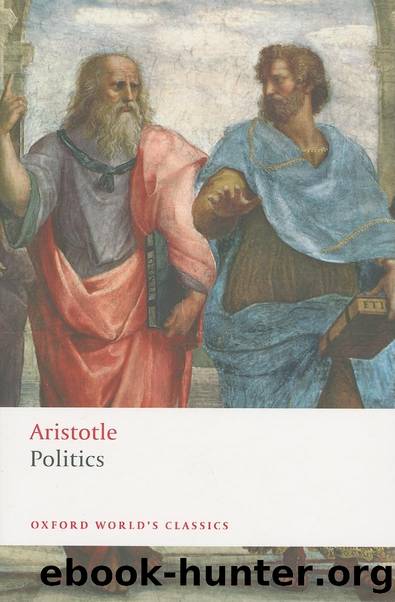
Author:Aristotle; Barker, Ernest; Stalley, R. F.
Language: eng
Format: epub
Publisher: Oxford University Press
Published: 1998-01-15T00:00:00+00:00
CHAPTER 7
3. Aristocracies. Here changes are due to a policy of narrowing the circle of the government. The collapse of aristocraciesâas also of âconstitutional governmentsâ (polities), which are closely alliedâis generally due to a defective balance of the different elements combined in the constitution: this may lead either to change in the direction in which the balance is tilted, or to violent reaction towards the opposite extreme. Aristocracies are particularly liable to be the victims of trifling occasions. All constitutions may be affected and undermined by the influence of powerful neighbouring cities.
1306b22 In aristocracies factional disputes may arise from the limitation of office and honours to a narrow circle. This is a cause which, as we have mentioned,* produces commotions in oligarchies; and it naturally affects aristocracies, because they too are in some sense oligarchies. In both types of constitutions, though for different reasons, the ruling class is small; and it is this common feature which will explain why an aristocracy may be regarded as a kind of oligarchy. This particularly tends to happen when there is a mass of people convinced that they are as good in character as the rulers. This was the case with those at Sparta called the Partheniae, who were the [illegitimate] sons of Spartan peers:* they conspired together but were detected, and sent out to colonize Tarentum. The same thing may happen when people of great ability, and second to none in their merits, are treated dishonourably by those who themselves enjoy higher honoursâas Lysander* was by the kings of Sparta. It may happen, again, when a man of high spiritâlike Cinadon, the leader of the conspiracy [in 398 BC] against the Spartan peers in the reign of king Agesilausâis debarred from honours and office. It may happen too, when some of the ruling class become excessively poor, and others excessively rich. This happens particularly in times of war. It happened, for example, at Sparta in the time of the Messenian War. The poem of Tyrtaeus, entitled âGood Governmentâ,* is sufficient evidence: it tells how people impoverished by the war demanded a redistribution of landed property. In addition someone who has a great position, and the capacity for a still greater, [will promote factional disputes] in order to make himself the one ruler. Pausanias,* who was general during the Persian War, is an example at Sparta; Hanno at Carthage is another.
1307a5 But the downfall of aristocracies, and also of âconstitutional governmentsâ [polities], is chiefly due to some deviation from justice in the constitution itself. In either case the origin of the downfall is a failure to combine different elements properly. In âconstitutional governmentsâ the elements are democracy and oligarchy: in aristocracies they are both of these and the further element of merit; but even in the latter the real difficulty is that of combining the first two elements, which are the ones that âconstitutional governmentsâ (as well as most of the so-called aristocracies) actually attempt to combine. The only difference between aristocracies and what
Download
This site does not store any files on its server. We only index and link to content provided by other sites. Please contact the content providers to delete copyright contents if any and email us, we'll remove relevant links or contents immediately.
Personalized inhaled bacteriophage therapy for treatment of multidrug-resistant Pseudomonas aeruginosa in cystic fibrosis by unknow(185325)
CONSORT 2025 statement: updated guideline for reporting randomized trials by unknow(93673)
Critical evaluation of the ProfiLER-02 study design and outcomes by Vivek Subbiah & Razelle Kurzrock(93459)
Cardiac gene therapy makes a comeback by Oliver J. Müller & Susanne Hille & Anca Kliesow Remes(93105)
Whisky: Malt Whiskies of Scotland (Collins Little Books) by dominic roskrow(74471)
Unveiling the design rules for tunable emission in graphene quantum dots: A high-throughput TDDFT and machine learning perspective by Şener Özönder & Mustafa Coşkun Özdemir & Caner Ünlü(50916)
A yeast-based oral therapeutic delivers immune checkpoint inhibitors to reduce intestinal tumor burden by unknow(40296)
Covalent hitchhikers guide proteins to the nucleus by Alexander F. Russell & Madeline F. Currie & Champak Chatterjee(40234)
Meet the Authors: Christopher R. Mansfield and Emily R. Derbyshire by Christopher R. Mansfield & Emily R. Derbyshire(40123)
Alkaline-earth metals promote propane dehydrogenation with carbon dioxide through geometric effects: Altering the reaction pathway by unknow(32761)
Induced iron vacancies boosting FeOOH loaded on sustainable Fenton-like collagen fiber membrane for efficient removal of emerging contaminants by unknow(32543)
Efficient electric-field-assisted photochemical conversion of methane to n-propanol exclusively over penetrated TiO2Ti hollow fibers by Guanghui Feng(32476)
Bi2SiO5 nanosheets as piezo-photocatalyst for efficient degradation of 2,4-Dichlorophenol by Hangyu Shi & Yifu Li & Lishan Zhang & Guoguan Liu & Qian Zhang & Xuan Ru & Shan Zhong(32414)
A novel NDIPTA organic heterojunction photocatalyst with built-in electric field for efficient hydrogen production by Jiahui Yang & Baojun Ma & Yongfa Zhu(32386)
Enhanced conversion of methane to liquid-phase oxygenates via hollow ferrite nanotube@horseradish peroxidase based photoenzymatic catalysis by Jun Duan & Shiying Fan & Xinyong Li & Shaomin Liu(32351)
Ordered macroporous superstructure of defective carbon adorned with tiny cobalt sulfide for selective electrocatalytic hydrogenation of cinnamaldehyde by Xiao-Shi Yuan & Sheng-Hua Zhou & San-Mei Wang & Wenbo Wei & Xiaofang Li & Xin-Tao Wu & Qi-Long Zhu(32274)
What's Done in Darkness by Kayla Perrin(27168)
Topological analysis of non-conjugated ethylene oxide cored dendrimers decorated with tetraphenylethylene: Insights from degree-based descriptors using the polynomial approach by A Theertha Nair & D Antony Xavier & Annmaria Baby & S Akhila(26557)
Investigation of mechanical and self-healing properties of hydroxyl-terminated polybutadiene functionalized with 2-ureido-4-pyrimidinone by Mohsen Kazazi & Mehran Hayaty & Ali Mousaviazar(26489)
